
ADHD burnout is what happens when the daily cost of managing your symptoms finally outruns your ability to pay it. Not a bad week. A crash: exhaustion that sleep doesn't fix, and tasks that used to be manageable turning impossible overnight.
ADHD burnout is a state of deep mental, emotional, and often physical exhaustion that builds from the constant extra effort ADHD brains spend just keeping up with regular life. Neurotypical burnout is usually tied to one clear source: an overloaded job, a caregiving load, a specific stretch of too much. ADHD burnout has that same trigger, plus a second layer running underneath it all the time: the effort of masking.
Masking is the work of looking like you have it together when your brain is actually working overtime to track time, remember things, filter out distractions, and manage impulses that come more easily to other people. It's invisible from the outside, so nobody around you sees the bill coming due. You just look "fine" until you very suddenly aren't.
It's different from ordinary burnout, and different from depression, even though it can look a lot like both. This guide covers the cycle that causes it, how to tell it apart from what it gets confused with, and what recovery looks like when you can't just quit your life and meditate on a mountain for six months.
ADHD burnout rarely comes from one bad event. It builds through a repeating cycle, and once you can name the stages, it gets a lot easier to catch earlier.
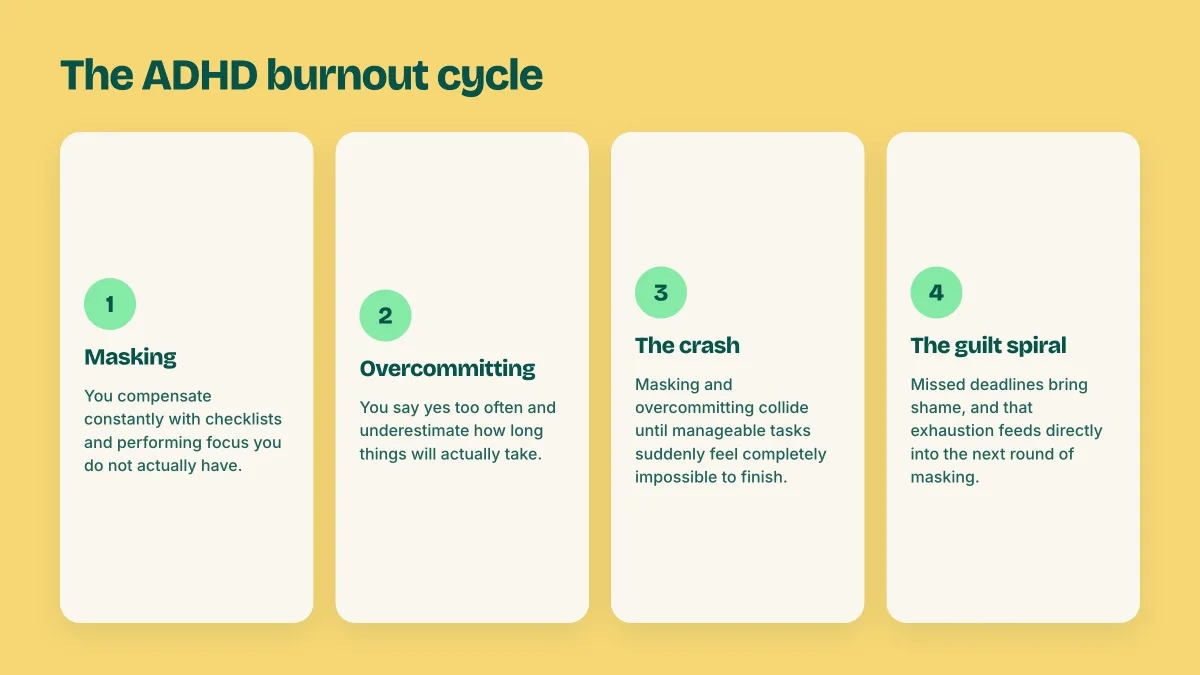
Masking. You compensate constantly: extra checklists, extra reminders, performing focus you don't actually have, staying on in every meeting. It works, but it costs far more energy than it looks like from outside.
Overcommitting. ADHD brains are often drawn to saying yes, underestimating how long things take, and piling on more because committing feels good and consequence-free. The bill arrives later, all at once.
The crash. Eventually the masking and the overcommitting collide with a finite amount of energy. Tasks that were manageable become impossible. Motivation disappears completely, and sleep, appetite, and mood usually go with it.
The guilt spiral. Missed deadlines and canceled plans bring shame, and shame is exhausting in its own right. That exhaustion folds into the next round of masking, because now there's more to compensate for.
Repeat. Without a change to the underlying system (not just willpower, the actual system), the cycle resets and runs again, usually faster, because the reserves that used to buffer it are already thinner.
The core difference is that ADHD burnout has two exhaustion sources stacked on top of each other where other burnout usually has one. A neurotypical brain managing a hard season is spending energy on the season. An ADHD brain in the same season is spending energy on the season and on the baseline cost of ADHD itself: task initiation, working memory, emotional regulation, time blindness, sensory filtering. That second cost never fully switches off, even on an easy week, which means the margin for absorbing a hard week is thinner from the start.
This is also why "just take a vacation" rarely fixes it the way it does for other kinds of burnout. A week off removes the season's extra load, but it doesn't touch the baseline tax. Real recovery has to address both.
Symptoms vary person to person, but the common ones cluster into a few groups.
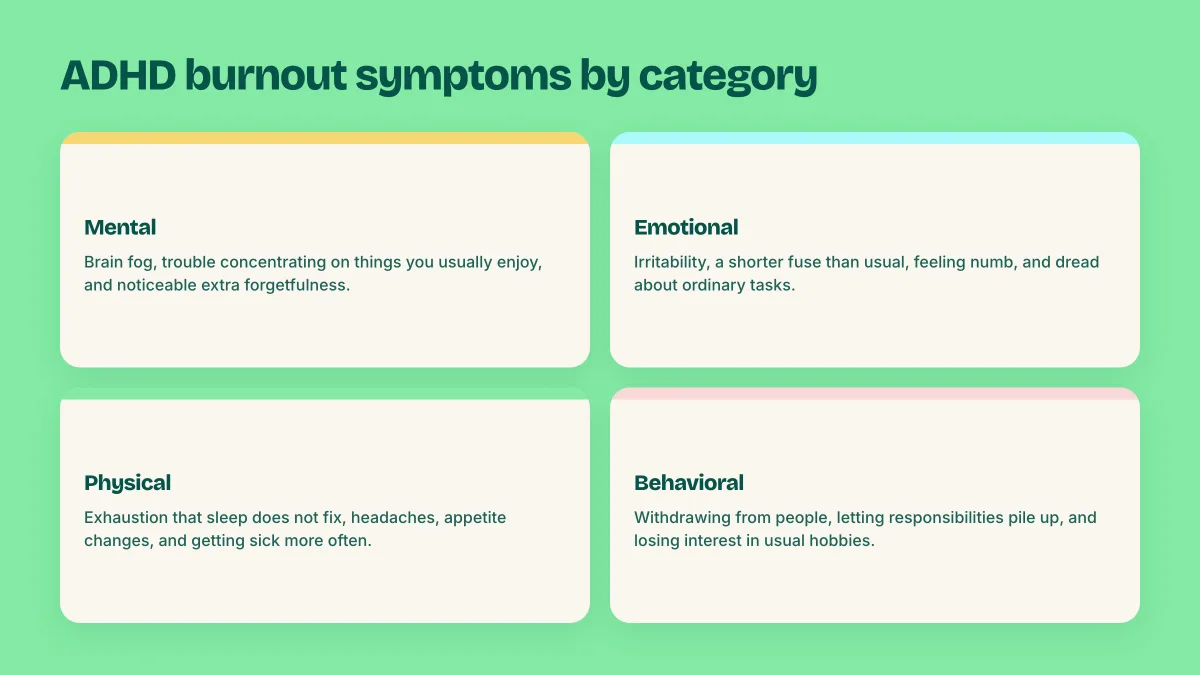
Mental Brain fog, trouble concentrating even on things you usually enjoy, decision fatigue over small choices, forgetfulness noticeably worse than your baseline.
Emotional Irritability, a shorter fuse than usual, feeling numb or detached, a sense of dread about tasks that used to be neutral.
Physical Exhaustion that doesn't improve with sleep, headaches, appetite changes, getting sick more often as your system runs down.
Behavioral Withdrawing from people, letting responsibilities pile up because starting feels impossible, losing interest in hobbies that used to be a refuge.
Executive What used to be manageable (replying to messages, starting simple tasks, following a routine) starts to feel disproportionately hard.
If several of these have been building for weeks rather than days, that's the burnout pattern rather than a rough patch.
ADHD burnout and depression can look similar from the outside (low energy, low motivation, withdrawal), and they can also happen at the same time, which makes this genuinely hard to untangle on your own. A few descriptive differences that clinicians point to: ADHD burnout tends to track closely with a period of overload and often lifts, at least partially, once the load and the masking both come down. Depression tends to persist independent of external circumstances and often includes a deeper, longer lasting low mood and loss of pleasure across the board, not just around tasks.
This is not a diagnostic tool, and we are not qualified to tell you which one you're experiencing. If low mood, loss of interest, or exhaustion has lasted more than a couple of weeks, or if it's affecting your safety, a doctor or therapist is the right next step, not a blog post. The two are also not mutually exclusive: plenty of people are managing both at once, and a professional can help sort out what's driving what.
There's no fixed timeline, and anyone who gives you an exact number is guessing. Mild episodes, caught early and addressed with real rest and a lighter load, can ease within a couple of weeks. Burnout that's built up over months of masking and overcommitting, especially without any change to the underlying pattern, can take months to recover from, and it tends to come back faster each time if nothing about the system changes.
The most reliable sign recovery is working isn't a date on a calendar. It's your baseline energy holding steady even on an average day, not just a good one.
You don't need a silent retreat or a total life overhaul to recover. You need less masking, fewer commitments, and enough structural support that staying afloat doesn't require constant extra effort. A few things that actually help.
Drop the performance, not the person. You don't owe everyone the put-together version of yourself while you're recovering. Let some things look messier for a while. That's the point.
Cut commitments before you feel ready to. Waiting until you feel recovered enough to say no is backwards. Say no first, recover second.
Protect sleep like it's a task, not a nice-to-have. ADHD brains are more sensitive to sleep debt, and recovery without sleep is mostly wishful thinking.
Lower the friction on the basics. Burnout is the worst possible time to rely on willpower for remembering things. Offloading your open loops removes one whole category of background effort while you recover the rest.
Let interest come back before productivity does. Forcing focus onto boring tasks while still depleted usually backfires. Let a genuinely interesting task be the first thing you re-engage with.
On that fourth point: during burnout is exactly when holding open loops in your head costs the most. A brain dump into something outside your head, rather than a mental list you're straining to hold, removes one entire category of background effort while you recover the rest.
Recovery gets you back to baseline. Prevention is what keeps you there, and it comes down to building systems with enough slack that one hard week doesn't tip you back into the cycle.
Build in slack, not just schedule. If your calendar has no room for a bad day, one bad day becomes a bad month.
Catch the early signs, not just the crash. Rising irritability, more forgotten small things than usual, and dread creeping into ordinary tasks all show up well before the full crash.
Make capturing effortless. Much of the daily masking tax comes from holding tasks and half-formed plans in your head because writing them down properly feels like its own task.
Build routines that survive a bad day. A system that only works at 100 percent fails you the moment you're not, which is exactly when you need it most. Aim for the version that holds at 60 percent.
Prevention isn't about becoming a different person who never gets overwhelmed. It's about lowering the daily cost of staying organized enough that overwhelm has further to climb before it turns into another crash. If planning itself is the part that feels impossible, the ADHD task manager side of Doot is built for exactly that.
Dump what's on your mind into Doot and let it carry the sorting, so staying organized stops costing you energy you don't have.
Try free for 7 daysarrow_forward