
TickTick is one of the most complete to do apps you can buy: task lists, a habit tracker, a built in Pomodoro timer, calendar view, an Eisenhower matrix, and more toggles hiding in settings than most people ever find. If you're looking for a TickTick alternative, it's probably not because TickTick is missing a feature. It's because using it started to feel like a second job.
That's a specific problem, and it deserves a specific answer. Doot is the alternative for people whose brain doesn't need more places to organize things, it needs the organizing done for it. No habit tracker to babysit, no calendar view to configure, no list of settings to get right before the app finally works the way you want. You dump what's in your head in plain English, typed or spoken, and Doot hands you back an organized task list.
Credit where it's due. TickTick earns its reputation:
- Recurring tasks and calendar sync that actually work, pulling in Google and Outlook calendars alongside your task list.
- A genuinely good Pomodoro timer built into the same app, so you're not juggling a separate timer tool.
- Habit tracking sitting next to your tasks, useful if you want both in one place.
- Natural language quick add that's fast once you've learned its shorthand for dates, tags, and priority.
- Cross platform support across web, desktop, iOS, and Android, at around $36 a year for premium, which is cheap for what it covers.
If you want one app to replace your task list, your habit tracker, and your calendar, TickTick vs almost anything else at that price is a fair fight it usually wins. For a lot of people, it's simply the right tool.
The same feature list that makes TickTick a strong all rounder is what makes it hard to live inside when your executive function is already stretched thin.
Every task asks for a decision before it asks for action: which list does this belong to, which tag, which priority flag, should it get a Pomodoro session. None of those decisions are hard on their own. Add them up across forty tasks in a bad week and they're the reason the app gets abandoned by Thursday.
The interface reflects the feature set: a sidebar, a calendar strip, tag filters, smart lists, habit widgets. Nothing about it is badly designed, there's just a lot of it on screen at once, and "a lot on screen" is exactly what an overloaded brain does not need.
TickTick is also built generically, for students, project managers, and productivity hobbyists alike. It's not written around ADHD attention or overwhelm specifically, so nothing in the app protects you from the setup tax: you get the most out of TickTick only after you've configured lists, tags, and views, and that configuration step is precisely the kind of task ADHD brains stall out on before they ever get to the tasks themselves.
None of this is a knock on TickTick's build quality. It's a mismatch between a maximalist tool and a brain that works better with less deciding and more doing.
TickTick vs Doot isn't an upgrade in either direction, it's a real trade off, and being honest about it matters more than winning the comparison. Stay with TickTick if:
- You want habit tracking and a Pomodoro timer living in the same app as your tasks.
- You like configuring views, tags, and smart lists, and doing it doesn't drain you.
- You're already deep in the ecosystem (calendar sync, widgets, integrations) and it's working for you.
Switch to Doot if that list reads like homework rather than a feature you'd use.
TickTick's free plan is already solid, so "free" isn't really where Doot competes. The difference isn't price, it's what happens the moment you open the app. A free plan with more features to configure doesn't solve overwhelm, it just delays the bill. Doot charges $4.99 a month (or $34.99 a year with a 14 day trial) for one job done well: turning your mess into a task list without asking you to build the system first.
If your search for a "ticktick free alternative" is really a search for "an app that doesn't need setup," that's a different problem than price, and it's the one Doot was built to solve.
Most apps like TickTick compete on the same axis TickTick already wins: more views, more integrations, more customization. Doot competes on the opposite axis.
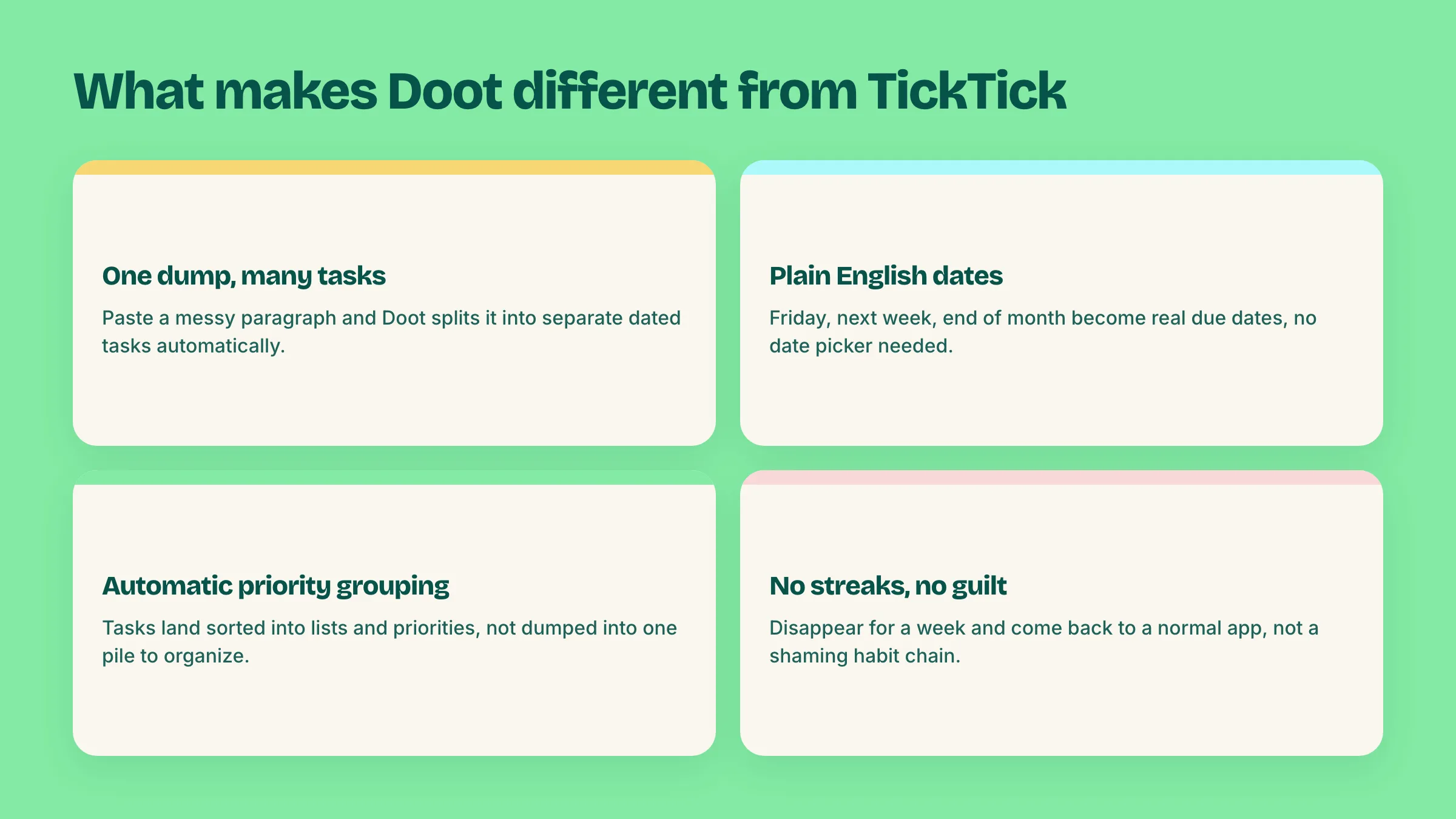
- One dump, many tasks. Paste or speak a whole messy paragraph. Doot splits it into separate tasks, so "call the dentist, finish the report by friday, don't forget mom's birthday" becomes three tasks, each with its own date.
- Plain English dates, no date picker. "Friday," "next week," and "end of month" become real due dates on their own.
- Automatic priority and list grouping. Tasks land sorted, not dumped into one undifferentiated pile you still have to organize.
- No streaks, no guilt. Disappear for a week and come back to a normal app, not a broken habit chain shaming you for it.
- No setup tax. There are no lists, tags, or views to configure before Doot is useful. It works from the first sentence you type or speak.
That's the whole shift: TickTick gives you more tools to organize your life. Doot does the organizing for you, so the tool gets out of the way.
If Todoist is also on your shortlist, we've written an honest breakdown of Todoist for ADHD: where it genuinely works, and where its project and label system starts to punish a messy week.
Try Doot and see what a task list looks like when you stop building the system yourself.
Try free for 14 daysarrow_forward