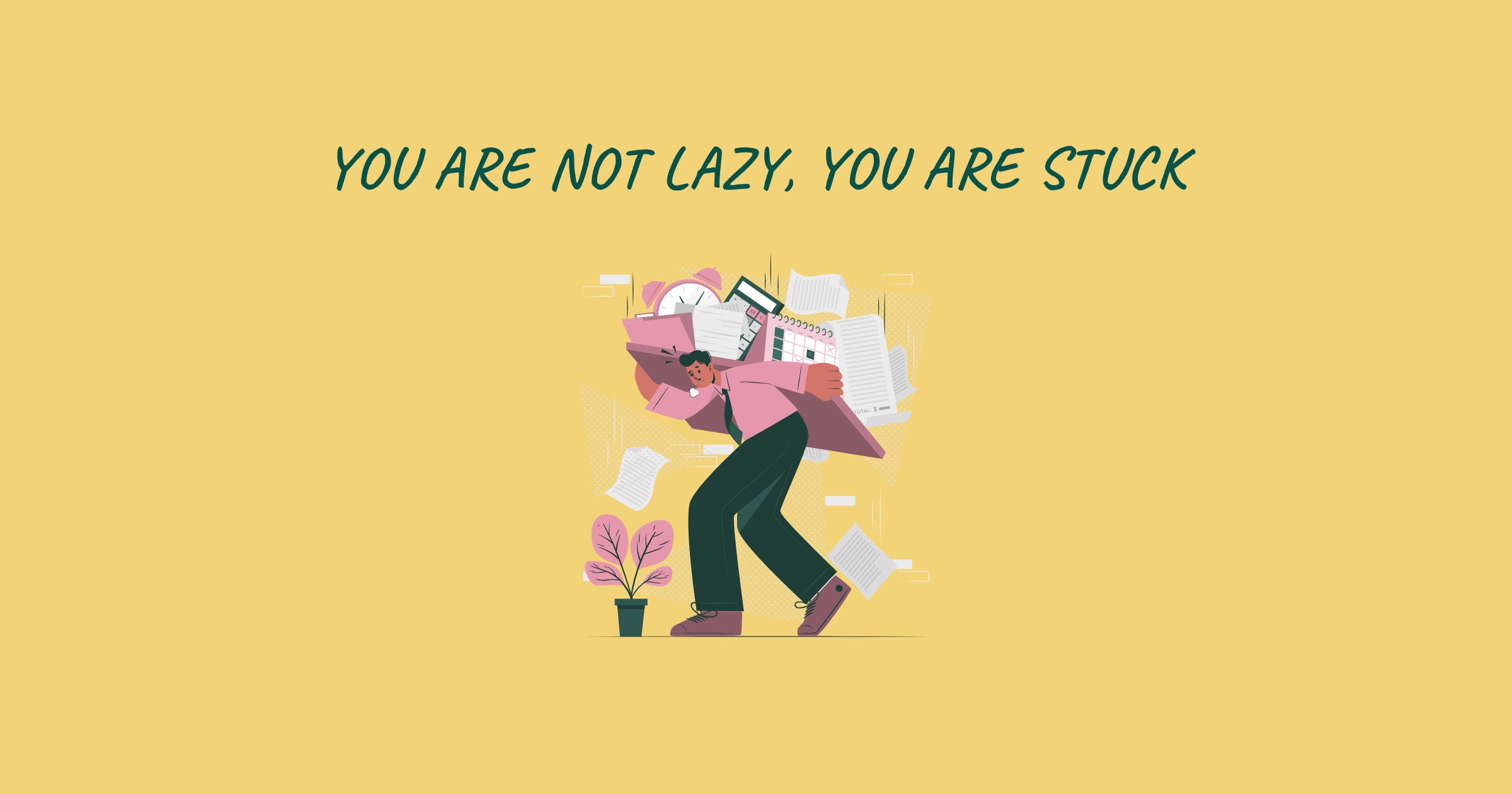
ADHD paralysis is the freeze that hits before a task even starts. You know what needs doing, you might even want to do it, and your body just will not move. It isn't procrastination in the classic sense. Procrastination is choosing to do something else. Paralysis is not being able to choose at all.
If this happens to you daily, you're not broken and you're not lazy. ADHD paralysis is a real, well documented pattern tied to how ADHD brains handle executive function under load. It has a shape, it has causes, and it has ways through it that don't depend on willpower. That's what this guide covers: what ADHD paralysis actually is, why it happens, and concrete moves to break it when you're stuck in it right now.
ADHD paralysis is what happens when your brain has too much to process (too many tasks, too many options, too much emotional weight) and instead of picking one thing, it locks up on all of them. It shows up in a few different flavors, and most people with ADHD experience all three at different times.
Task paralysis. You're staring at your to-do list, everything on it feels equally urgent and equally impossible, and you end up doing none of it. Not because you don't care. Because you can't find the thread to pull first.
Choice paralysis (also called decision paralysis). Ordering dinner, picking which email to answer first, deciding what to wear. ADHD choice paralysis turns small decisions into full stops, because your brain can't rank the options fast enough to just pick one.
Mental paralysis. The quieter version. No visible task in front of you, just a fog where your thoughts won't organize into a next move. You feel busy inside your head and completely stuck outside it.
People also describe a version close to analysis paralysis, where you research and plan a task so thoroughly that the planning itself becomes the block. Different entry points, same exit: nothing happens.
ADHD paralysis comes down to executive function, the mental toolkit your brain uses to start tasks, hold a plan, and switch between steps. In ADHD brains, that toolkit is inconsistent under load, not missing. The tools are there. Getting them to fire on command, especially for tasks with no immediate reward, is the part that's hard.
A few things stack up to cause the freeze:
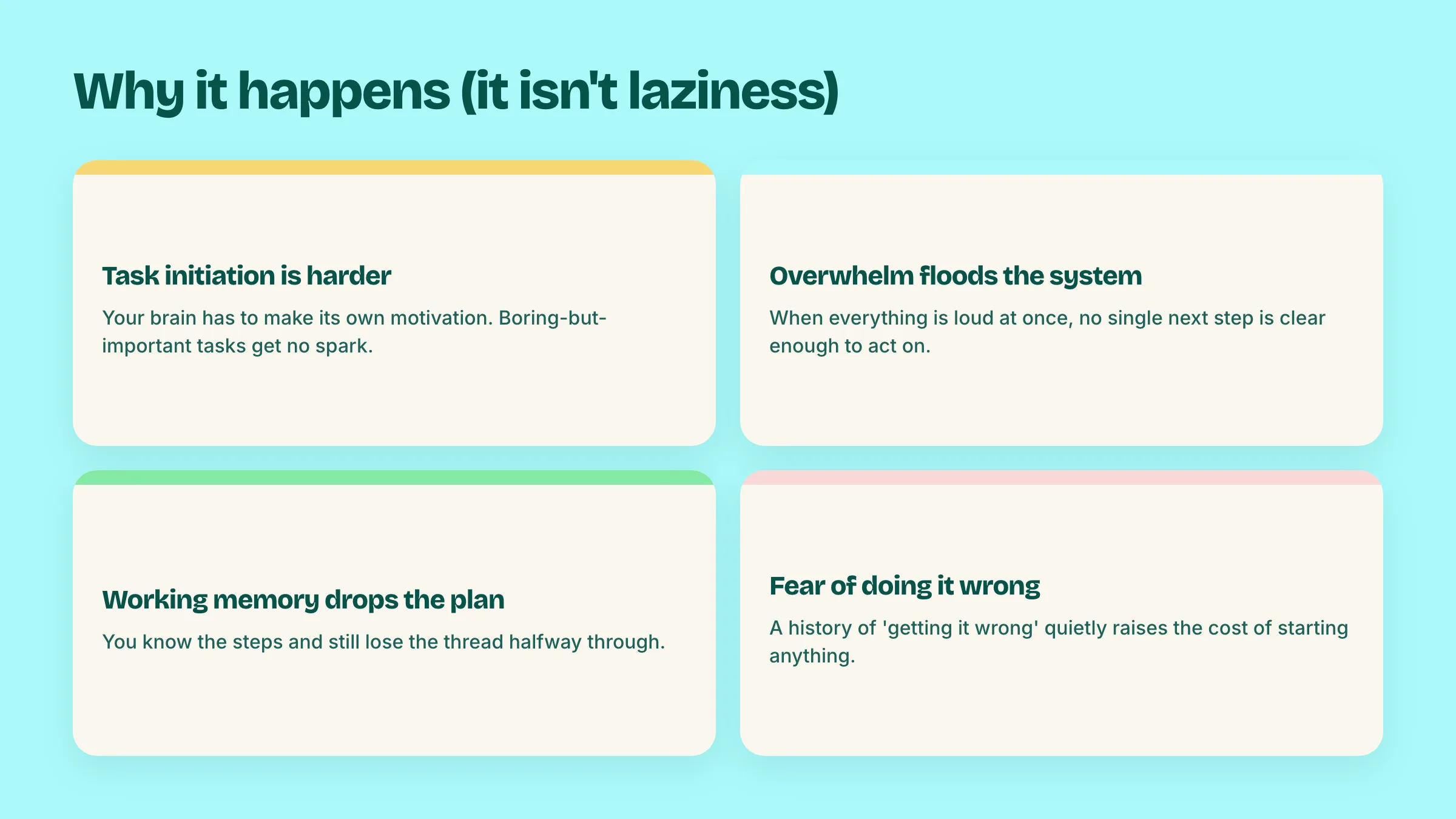
- Task initiation is genuinely harder. Starting a task requires your brain to generate its own motivation for it. ADHD brains rely more on interest, novelty, urgency, or pressure to get that spark, so a boring but important task can sit untouched for weeks while something interesting gets done instantly.
- Overwhelm floods the system. A messy inbox, a long list, and three open browser tabs of half-finished tasks all compete for attention at once. When everything is loud, your brain can't hear any single next step clearly enough to act on it.
- Working memory drops the plan. You can know the steps and still lose the thread halfway through, because ADHD working memory holds fewer things at once and drops them faster.
- The fear of doing it wrong adds a second layer. Many people with ADHD have a long history of starting something and doing it "wrong," which quietly raises the cost of starting anything new. The brain treats the risk of failing as a reason to not begin at all.
None of that is a character flaw. It's a brain managing more inputs than its current bandwidth can rank and sequence. Treating it like a laziness problem (more willpower, more discipline) doesn't work, because willpower was never the bottleneck.
The way out of ADHD paralysis is almost never "push harder." It's removing the parts of the task that are actually causing the freeze: the size of the first step, the invisibility of the plan, or the total number of open loops competing for attention.
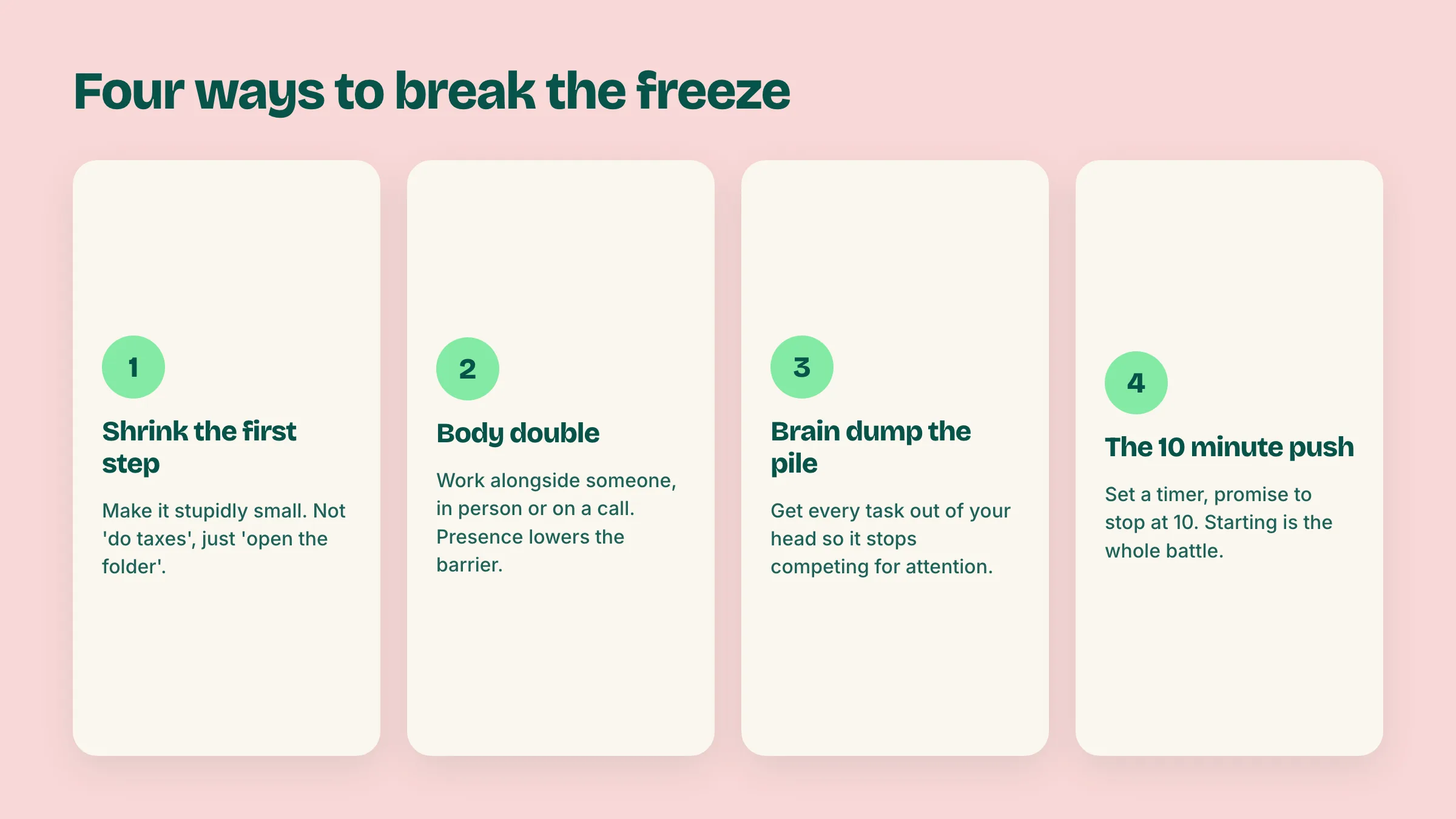
Most stuck tasks aren't actually one task. "Clean the kitchen" is really twenty small tasks wearing one big name. Your brain looks at the whole pile and locks up. Break it down until the very first action takes less effort than continuing to sit there: not "write the report," but "open the document." Not "do laundry," but "carry the basket to the machine." The goal isn't to trick yourself. It's to make step one small enough that starting doesn't require willpower, just motion.
Body doubling means doing the task in the presence of another person, in person or on a video call, even if they're doing something completely different. Nobody fully understands why it works this well for ADHD brains, but the effect is consistent: another person's presence adds just enough external structure to pull you out of the freeze and into motion. If you don't have a body double on hand, even a timer with a visible countdown or a livestream of someone else working can do a smaller version of the same job.
A lot of ADHD paralysis is really a traffic jam of unrelated thoughts: three work tasks, a text you owe someone, a bill, an appointment you're dreading, all crammed into working memory at once with nowhere to land. Getting all of it out of your head and into one place, without sorting or judging any of it as you go, clears enough space for one thing to become visible again.
This is the exact gap Doot is built to close. You brain dump everything on your mind in one messy paragraph, typed or spoken, and Doot's AI turns it into actual tasks with dates and priorities. You're not organizing while paralyzed, which is the part that usually fails. You're dumping, and the structure comes back to you already sorted. Once the pile has a shape again, picking a first step gets a lot easier.
Commit to just ten minutes on the task, with an actual timer, and permission to stop when it goes off. Ten minutes is short enough that almost nobody's brain vetoes it, and it's long enough to break the seal that paralysis puts on starting. Most of the time, the ten minutes turns into more once you're actually moving, because momentum is easier to keep than to create. If it doesn't, you still did ten minutes you wouldn't have done otherwise, and that counts.
Where paralysis is more about choice than about starting, cut the options before you face them. Pick tomorrow's outfit tonight. Default to the same lunch three days a week. Let a coin flip decide between two equally fine options instead of debating them for twenty minutes. None of these decisions matter enough to earn the mental cost ADHD choice paralysis charges for them.
Everyone freezes on a task now and then. If ADHD paralysis is a daily pattern that's costing you your job, your relationships, or your sense of who you are, that's worth more than a blog post's worth of tips. A therapist or ADHD-informed coach can help you build a plan around your specific triggers, and a doctor can talk through whether medication or a formal evaluation makes sense for you. Nothing here is medical advice, and if the freeze comes with a low mood that doesn't lift, it's worth ruling out burnout or depression alongside it. (We cover the burnout side of this separately, since the two often show up together.)
Brain dump whatever's stuck in your head and let Doot hand back the one thing to do next.
Try free for 14 daysarrow_forward