Executive dysfunction is what happens when the brain's management system, the part that starts tasks, holds information in mind, plans steps, and keeps emotions in check, isn't working the way the moment needs. You know what needs doing. You might even want to do it. Some part of the process between knowing and doing quietly fails anyway, and it's not because you don't care enough.
It's one of the most misunderstood experiences in ADHD, autism, depression, anxiety, and plenty of brains with no diagnosis at all, mostly because it looks exactly like laziness from the outside and feels nothing like it from the inside. This page walks through what executive function actually covers, what dysfunction feels like in ordinary moments, why the usual advice makes it worse, and what scaffolding genuinely helps.
One thing upfront: this page is written to explain and support, not diagnose. If this is affecting your work, relationships, or how you feel about yourself day to day, a doctor, psychologist, or therapist who works with executive function can give you a real assessment. What follows is context, not a substitute for one.
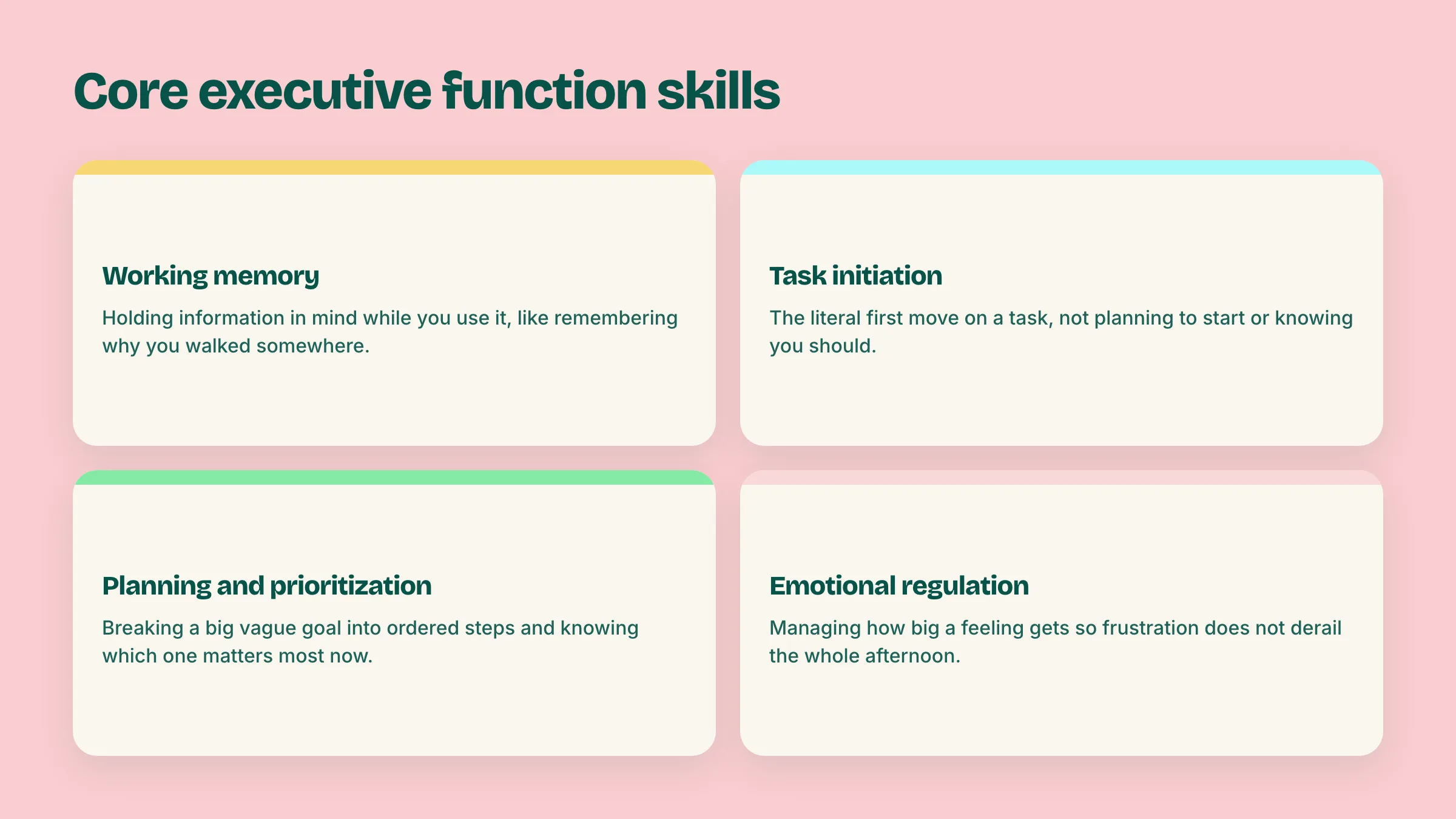
"Executive function" is an umbrella term for the mental skills that manage everything else you do. It's not one skill, it's a set of them, and most people never think about any of them individually because they mostly run in the background. A few of the big ones:
- Working memory. Holding information in mind while you use it: remembering the three things you walked into the kitchen for, keeping a conversation's earlier point in mind while someone's still talking, doing mental math without writing it down.
- Task initiation. The literal act of starting. Not planning to start, not knowing you should start, the actual first move. This is the one people are hardest on themselves about, because it looks like "just do it" should apply, and it doesn't work that way here.
- Planning and prioritization. Breaking a big vague goal into an ordered set of smaller steps, and figuring out which step matters most right now versus which one merely feels loud.
- Emotional regulation. Managing the intensity of a feeling so it doesn't take over the wheel: frustration at a broken printer that doesn't derail the whole afternoon, disappointment that doesn't spiral into giving up entirely.
- Cognitive flexibility. Shifting between tasks or ideas without getting stuck, and adjusting a plan when the situation changes instead of freezing because "that's not what was supposed to happen."
- Self-monitoring. Noticing, in real time, how you're doing: are you on track, off track, taking too long, missing something. The internal check-in most people run without noticing they're running it.
Executive dysfunction is what it looks like when one or several of these are impaired, whether that's chronic (as in ADHD or autism) or situational (stress, poor sleep, depression, grief). The skills aren't gone. They're unreliable, which is a very different and much more frustrating thing to live with than simply lacking them.
Executive dysfunction rarely shows up as one dramatic failure. It shows up as small, repeated moments that add up to a life that feels harder than it should:
- Knowing exactly what to do and still not starting it. The task is clear, even easy. You've been "about to start" for forty-five minutes. This is task initiation failing, and it has nothing to do with how much you want the task done.
- Losing the plan mid-task. You sit down to do one thing, and twenty minutes later you're doing something else entirely, not because you got distracted by something exciting, but because the original plan simply didn't stay held in mind.
- A messy inbox, a messy room, and a messy calendar, all for the same underlying reason. Planning and prioritization struggling means everything defaults to whatever's loudest right now, which rarely lines up with what actually matters.
- A small frustration turning into a full stop. The app crashes, a form won't submit, someone gives unexpected feedback, and the whole task gets abandoned. Not because the setback was actually large, but because emotional regulation ran out of runway before problem-solving could take over.
- Time blindness alongside all of it. Poor time perception is close enough to executive function that the two usually travel together. If you want the deep dive on that piece specifically, see time blindness.
- Total shutdown when there's too much at once. When several tasks stack up and none of them get prioritized, the whole pile can become impossible to face at all. That specific freeze has its own name and its own fixes: see ADHD paralysis.
None of this is a discipline problem. Discipline assumes the machinery for starting, holding, and prioritizing tasks is intact and the only missing ingredient is willpower. Executive dysfunction is what happens when the machinery itself is the unreliable part.
The advice people get is almost always some version of "you just need to be more disciplined" or "make a list and stick to it." It fails for a specific, structural reason: trying harder recruits more of the exact resource that's already struggling.
If working memory is the weak link, gritting your teeth doesn't add working memory capacity, the same way squinting harder doesn't fix a blurry prescription. If task initiation is the problem, willpower can occasionally force a start through pure discomfort, but it's expensive, it doesn't scale to a whole day of tasks, and it leaves nothing left over for anything else. People with executive dysfunction often have tried harder for years. The pile of "I should just" advice they've absorbed is usually the reason they feel worse about this, not the reason they've fixed it.
The useful shift is realizing this isn't a motivation gap to close with effort. It's a systems gap, and systems gaps get closed with scaffolding, not with trying harder at the same unsupported approach.
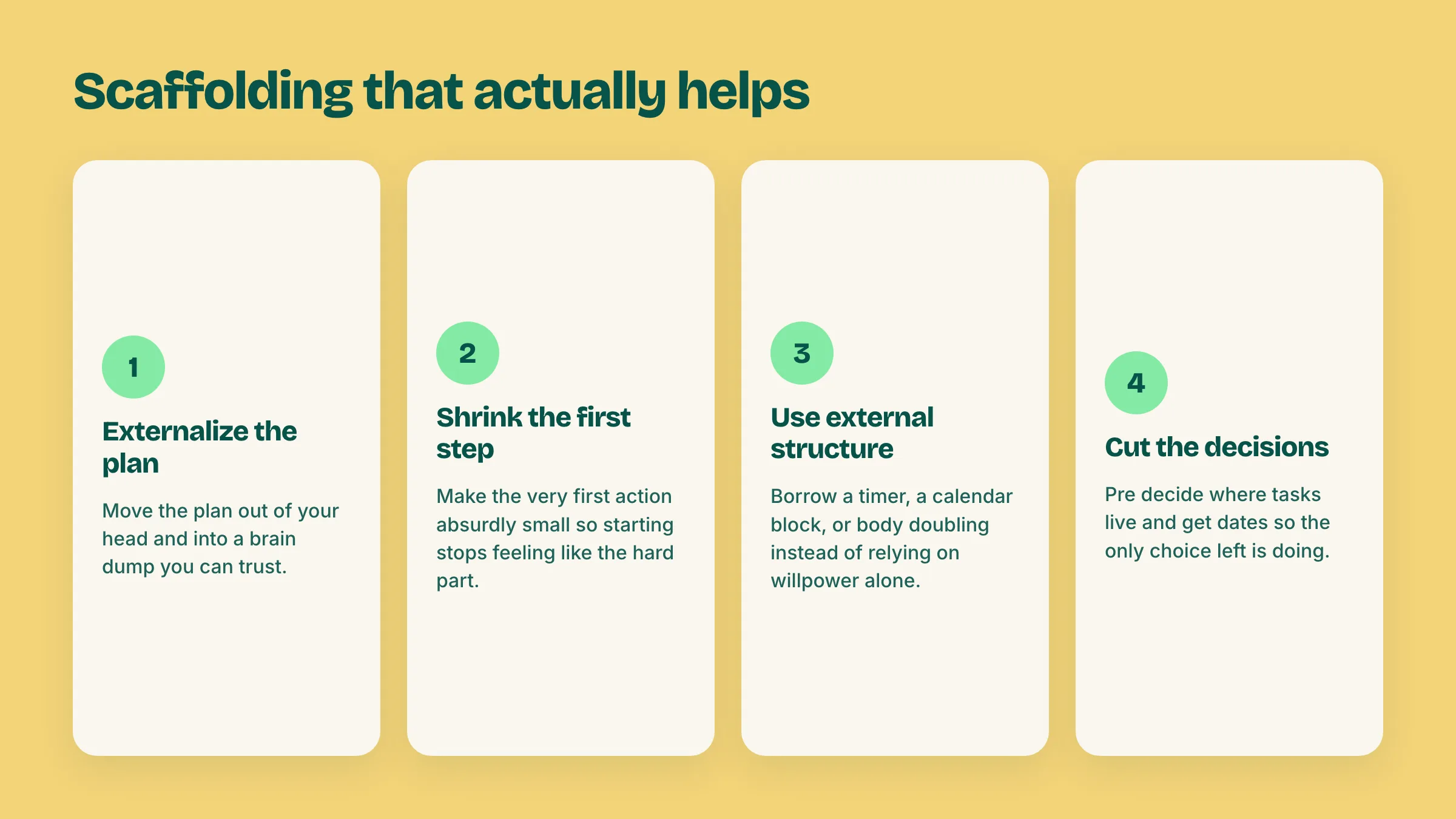
The fixes that work share one thing in common: they move the work outside the brain's unreliable executive function and into something external, visible, and repeatable, so the brain doesn't have to run the whole process unsupported every single time.
Externalize the plan instead of holding it in your head. Working memory failing means anything living only in your head is at risk of disappearing mid-task. A brain dump, done regularly, moves everything out of your head and into one place you trust, so the plan doesn't depend on remembering the plan. Our brain dump guide covers the method in depth, and it's one of the single highest-leverage habits for executive dysfunction specifically.
Make the first step absurdly small. Task initiation doesn't care how important the task is, it cares how big the first visible action looks. "Write the report" stalls. "Open the document and write one sentence" often doesn't, because the barrier to entry is lower than the resistance to starting.
Use externally imposed structure, not internally generated willpower. A timer that says stop, a calendar block that says start now, a person you've told you'll check in with (body doubling), all borrow structure from outside instead of demanding it be generated from inside. This is also the logic behind good ADHD task management tools: they should hold structure for you, not just store your list and assume you'll supply the structure yourself.
Reduce the number of decisions between "should do" and "doing." Every extra choice (which app, which list, what order, what's due first) is a place executive dysfunction can snag. Pre-decide as much as possible: one place tasks live, one place they get dates, one review time each day, so the only real decision left is doing the next thing.
Build in recovery, not just prevention. Systems fail sometimes. A day where nothing got started isn't proof the system doesn't work, it's a normal data point. The scaffolding that lasts includes an easy way back in (a short re-dump, a five minute review) rather than requiring you to have never fallen off in the first place.
Doot is built around the two places executive dysfunction bites hardest: holding a plan in mind, and turning "I should do this" into an actual first step. Brain dump everything on your mind, typed or spoken, in whatever messy order it comes out, and Doot turns it into dated, prioritized tasks automatically. The plan lives outside your head from the moment you say it, so working memory doesn't have to hold onto it, and there's no separate organizing step waiting to become the thing that stalls you.
Brain dump the whole tangled list and let Doot turn it into dated tasks your working memory doesn't have to hold onto.
Try free for 14 daysarrow_forward